Note: This publication is the culmination of advice given by our dear Shaykh in person since late February. An initial written version was published and distributed widely on the 14th of March 2020. This was followed by a second and final version published and distributed early on the 15th of March 2020 (before 1:00 am in the morning, or just after midnight, Australian Eastern Daylight Savings Time) in Melbourne, Australia.
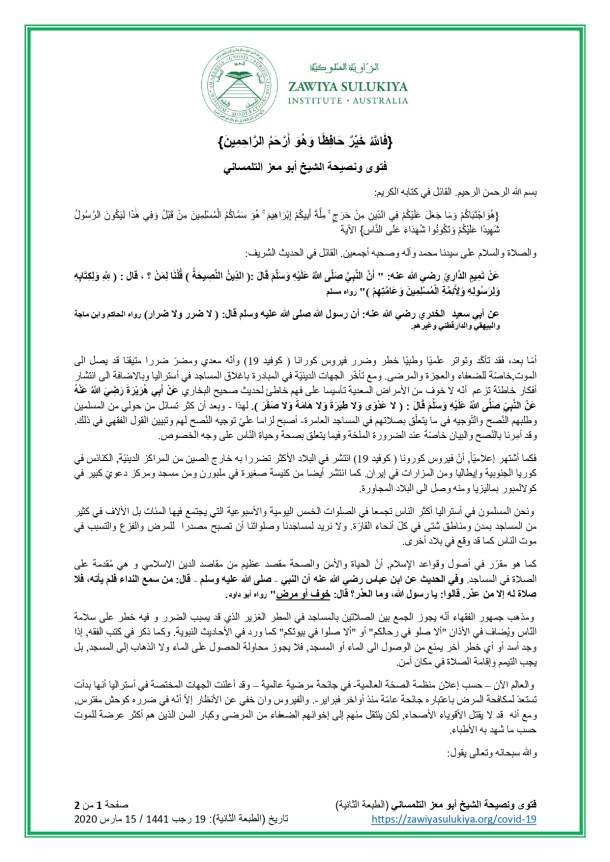
للتنبيه: هذه المقالة خلاصة نصائح سيدنا الشيخ منذ أواخر فبراير. نسخة أولى من المقالة قد طبعت ونشرت بين الناس بتاريخ 14 مارس. والنسخة الثانية طبعت ونشرت في بداية تاريخ 15 مارس قبل الساعة الواحدة صباحا بتوقيت ملبورن, أستراليا
“فالله خير حافظا وهو أرحم الراحمين”
“But ALLAH is the best guardian and HE is the Most Merciful of the merciful.” (Surah Yusuf)
Fatwa and Advice from Shaykh Abu Mouiz al-Tilimsani
In the Name of ALLAH, the Most Gracious, the Most Merciful, who says in His Noble Book:
“HE has chosen you and placed no hardship in your religion, the faith of your forefather Ibrahim. HE has called you Muslims––both in the past and in this [message]––so that the Messenger may be a witness over you and you may be witnesses over the people.” (Surah al-Hajj)
And may prayers and peace be upon our Master Muhammad, his family and companions altogether. He who said in a Hadith related by Tamim al-Dari, may ALLAH be pleased with him:
“Religion is sincere advice (or sincerity).” We asked: For whom? He answered: “For ALLAH, His Book, His Messenger, and for the leaders of the Muslims and their common folk.” (Narrated by Muslim)
In another Hadith related by Abu Sai’d al-Khudari, may ALLAH be pleased with him, the Messenger of ALLAH ﷺ said:
“There should be no harm nor reciprocating harm.”
(Narrated by Hakim, Ibn Majah, Bayhaqi, Daraqutni and others)
To proceed, the danger of the Coronavirus disease 2019 (COVID-19) has been established through medical science. It has been decisively determined that the virus is harmful and infectious and could lead to death, especially among the weak, the elderly and those with pre-existing illnesses. Yet the religious leadership has not moved swiftly to close mosques in Australia, and incorrect interpretations have been circulated claiming that there should be no fear from infectious diseases based on a wrong understanding of a Hadith narrated by Bukhari (that “There is no ‘adwa…”). For this reason, and after numerous questions reached me from Muslims seeking advice and direction regarding their prayer in mosques, it became obligatory upon me to sincerely advise them and clarify the position of the Sacred Law. We have been commanded to provide advice and clarification, especially in circumstances of pressing need—and particularly in matters related to health and human life.
As has been widely reported, COVID-19 has spread—in the most affected countries outside China—from religious centres: that is, from churches in South Korea and Italy and from mausoleums in Iran. The disease has also spread from a small chapel in Melbourne and a large mosque and da’wa centre in Malaysia from which it spread to neighbouring countries.
The danger of this virus is compounded by the observation of medical professionals that it can spread from person to person before its symptoms appear. This makes it impossible to know for certain who should stay away from public gatherings.
As Muslims in Australia, we are the people who most frequently gather for daily and weekly prayers by the hundreds or rather, by the thousands, in mosques located in different suburbs and cities all around the country. We do not want our mosques and prayers to become a source of illness, alarm or the cause of human death as has occurred in other countries.
It is established in the foundations and principles of Islam that life, safety and health comprise a central objective of the religion. This objective is prioritised above prayer in the mosque. And in a Hadith narrated on the authority of Ibn Abbas, may ALLAH be pleased with them both, the Prophet ﷺ said: “Whoever hears the call and does not come, his prayer is not valid, except for those who have an excuse.” They asked: “And what is the excuse?” He answered: “Fear or illness.” (Narrated by Abu Dawud).
The position of the majority of Jurists is that joining two prayers in the mosque is allowed when there is heavy rain which could cause harm or pose a danger to people’s safety, and the following phrase is added to the adhan: “Pray in your homes” as narrated in Prophetic Hadiths. It is also mentioned in the books of jurisprudence that if a danger such as a predatory animal blocks the way to water or the mosque, then in this case it would be forbidden to try to obtain water for ablutions (wudu) or to try to reach the mosque; it would rather be necessary to make dry ablution (tayammum) and conduct the prayer in a safe area.
As announced by the World Health Organisation, we are currently in a global COVID-19 pandemic. Australian authorities have also announced that they have been preparing to combat this virus as a pandemic since late February. While the virus may not be visible to the human eye, it is similar to a predatory beast; and while the virus may not kill the strong and healthy, it may pass from them to their weaker brothers and sisters, that is, those with pre-existing illnesses and the elderly who are most vulnerable to COVID-19 induced death as observed by medical Doctors.
ALLAH the Exalted says:
“On that account We decreed to the Children of Israel that if anyone kills a person- unless in retribution for murder or spreading corruption in the land- it is as if he kills all mankind, while if anyone saves a life it is as if he saves the lives of all mankind. Our messengers came to them with clear signs, but many of them continued to commit excesses in the land.” (Surah al-Ma’idah)
And the Prophet ﷺ said:
“Whoever aids someone in killing a Muslim, even if with merely one word, he shall meet Allah Mighty and Glorious on the Day of Resurrection with the following phrase inscribed on his forehead, ‘In complete despair of ALLAH’s mercy’.”
While the transmission of this Hadith may be weak, its meaning conforms with the higher objectives of the Sacred Law and its concern with protecting human life and honour.
The meaning of the aforementioned verse (ayah) contains enough by way of explaining the gravity of killing a soul, which is a major sin (kabira). And whatever action supports the commitment of a major sin (kabira) or prohibition (haram) carries the same ruling. Islam forbids killing and other major sins and prohibitions, and likewise forbids the means which lead to them. This is established in the principles and foundations of the Sacred Law. Imam ‘Izz al-Din ibn ‘Abd al-Salaam said in his book Qawa’id al-Ahkam fi Masalih al-Anam:
“If you want to know the difference between a minor sin (saghira) and a major sin (kabira), then compare the evil/harm of the sin (dhanb) with the evils of the major sins that have been textually determined. If the evil brought about is less than the least evil among the major sins, then it is a minor sin; but if it equals or exceeds the least evil among the major sins, then it is also a major sin.”
Therefore, when one finds what likely leads to causing death among people, it is obligatory to take precautions and distance oneself from what leads to the causes of death. This is done out of precaution (ihtiyat) and to block the means leading to evil (sadd al-dhari’a).
The Prophet ﷺ prohibited proximity to infectious diseases, and he prescribed quarantining to prevent the spread of illness, as practiced and prescribed in modern medicine:
On the authority of Usama ibn Zayd, may ALLAH be pleased with him, the Prophet ﷺ said:
“If you hear of plague in a land, then do not enter it. And if it comes to a land while you are there, then do not leave it.”
(Narrated by Bukhari and Muslim)
On the authority of Sharid ibn Suwayd al-Thaqafi, may ALLAH be pleased with him, who said:
Among the delegation of Thaqif was a leper. The Messenger of ALLAH ﷺ sent a message to him: “We have accepted your allegiance so go back.”
(Narrated by Muslim)
On the authority of Ibn Abi Awfa, may ALLAH be pleased with them, he ﷺ said:
“Speak to the leper from a distance of one spear or two spears.”
(Narrated by Abu Na’im)
One spear was equivalent to about 1.5 to 1.7 metres, two spears being about 3 to 3.4 metres.
Based on this explanation, and having observed the delay among Islamic religious leaders in Australia in closing Mosques, it became obligatory and specifically incumbent upon me as an Islamic scholar to sincerely advise the Muslims to fulfil the obligation of advice and clarification. ALLAH the Exalted says:
And when ALLAH took a covenant from those who were given the Scripture, “You must make it clear to the people and not conceal it.” (Surah Ali ‘Imran)
On the authority of Abu Hurayra, may ALLAH be pleased with him, the Messenger of ALLAH ﷺ said:
“Whoever is asked about knowledge and conceals it, ALLAH will bridle him with a bridle made of fire on the Day of Judgment.”
(Narrated by Abu Dawud, Tirmidhi and Ibn Majah)
I had hoped that this clarification and advice would be issued by others who occupy positions and centres of religious responsibility and authority.
My Fatwa and advice for Muslims in Australia is to stop the Jumu’a prayer and all prayers and religious gatherings at mosques and religious centres. This includes all daily prayers, Tarawih prayers, lectures or speeches and all communal religious rites and activities. I advise those who look after mosques and religious centres to close them until this pandemic passes. This is to protect themselves and their society, to comply with the advice and directions of medical and governmental authorities, and to realise the common good for all people.
O ALLAH, I have conveyed, explained and given sincere advice. And ALLAH knows best, and HE is the ONE who grants success in reaching that which is right and good for all people.
O ALLAH, grant us understanding of the religion and teach us interpretation. O ALLAH make us keys to goodness and locks to evil.
And all praise belongs to ALLAH in the beginning and the end. And may prayers and peace be upon our Master Muhammad, his family and companions.
Written and dictated to explain and to advise by the needy servant of his LORD,
Shaykh Abu Mouiz al-Tilimsani, may ALLAH forgive him, his parents and his teachers.
(Translated from the original Arabic by the Fuqara of the Zawiya Sulukiya Institute)
Arabic Original (2 pages):
للتنبيه: هذه المقالة خلاصة نصائح سيدنا الشيخ منذ أواخر فبراير. نسخة أولى من المقالة قد طبعت ونشرت بين الناس بتاريخ 14 مارس. والنسخة الثانية طبعت ونشرت في بداية تاريخ 15 مارس قبل الساعة الواحدة صباحا بتوقيت ملبورن, أستراليا

English (4 pages):
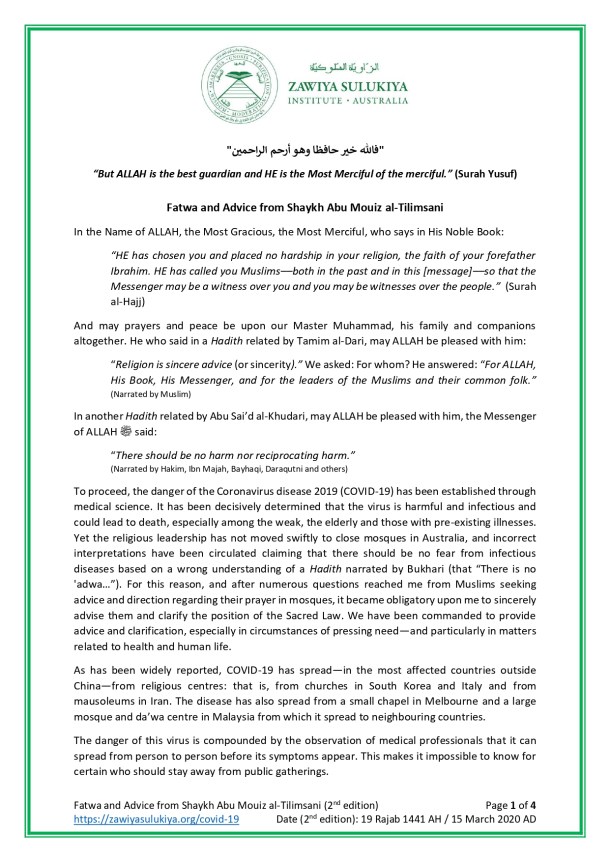
Note: This publication is the culmination of advice given by our dear Shaykh in person since late February. An initial written version was published and distributed widely on the 14th of March. This was followed by a second and final version published and distributed early on the 15th of March (before 1:00 am in the morning, or just after midnight, Australian Eastern Daylight Savings Time) in Melbourne, Australia.

 Zawiya Sulukiya Institute