Zawiya Sulukiya Institute
Zawiya Sulukiya Institute is a Melbourne based, not-for-profit organization for Islamic learning and lifestyle, promoting the balanced path of revelation, Prophetic knowledge and soul purification as well as intellectual development for contemporary multicultural Australian relevance.
We address both the Muslim and non-Muslim communities of all ages, offering information about Islam in a practical environment as a way of life. We help serve the community through educational classes, hosting both academic and family events. We also provide religious guidance and counselling, encouraging the youth to become positive role models for the wider society. To achieve this, the Institute is based on five interconnecting pillars, built on the grounds of Islamic principles. Namely, these pillars are:
1. ‘Gnosis’ with education
2. ‘Purification’ & service
3. ‘Awareness’ of higher thought
4. ‘Moderation’ (wasatiyya) with balance
5. ‘Wisdom’ for practice.
Taking into consideration the practical nature of the religion for time poor modern lifestyles, the Gnosis component represents the dissemination of Islamic sacred sciences through classes, addressed from basics to advanced levels. With additional development in purification and awareness, committed students of knowledge would progress to further levels.
Purification is symbolic of personal development and guidance by a Sunni Tassawwuf path (Tazkiyah & Suluk), incorporating self-awareness and purification of the heart and ego (nafs). It ultimately teaches one to be a positive human being and helps contribute to the wider society through mercy, ethics, courtesies (adab) and all values true to the Quranic and Prophetic teachings. It is instilled through understanding the issue of tarbiya while learning to be a wayfarer (salik) and a servant of Allah (faqir) through the practical elements of Islam. These include engaging in worship (ibadah) and litanies (wird). To purify one’s heart is to serve humanity through such causes as volunteering and serving the society, irrespective of religion, class or culture.
Awareness represents the activities of higher thought involving socio-political, economic and cultural understandings of the times we live in. An open heart needs an open mind, achieved by being aware of contemporary issues in order to become a conscious citizen of the current times. The awareness courses taken by academics and professionals include seminars and workshops covering numerous areas from history and philosophy to sociology, anthropology and psychology.
Moderation reflects the distinct middle path of Islam that encourages Muslims to maintain contemporary Islamic customs while highlighting the common cultural aspects of the Islamic and Australian traditions. Inclusive of entertainment for the youth and family events alike, wasatiyya is instilled by understanding the balance of religious values in the social, cultural and political contexts of greater Australian society.
Wisdom is the result of understanding knowledge that is derived from tasting the sweetness of Islamic practices and spiritual experiences. Allah Almighty states in the Quran that the bearers of wisdom have infinite goodness. Through wisdom we are able to work effectively with others for the commonweal of all. The Messenger of Allah  is reported to have said:
‘All creatures are the dependants of Allah, and the dearest to Allah are those who are most beneficial to His dependants.’
[narrated by Abu Ya’la 65/6; Tabarani in al-Mu’jam al-Kabir; and others]
The Wisdom and Philosophy of Zawiya Sulukiya Institute
The wisdom and philosophy of the Zawiya Sulukiya is based upon faqr. While linguistically faqr denotes one in need or in a state of destitution or poverty, a spiritual faqir is one who is poor yet not in need of the material but is in every need of Allah and His Divine presence.
It is a state of poverty through choice that one endures, for this poverty is not related to wealth but the dignity in attaining a spiritual state of detachment. One who refuses wealth, status, and fame refuses to fall prey to worldly comforts and luxuries. To be a faqir is to dispel all ego and grandeur not only when entering into the presence of beneficial knowledge but also in the very essence of one’s character.
The concept of faqr appears in the Holy Quran numerous times:
“O my Sustainer! Verily, in dire need am I of any good which You may bestow upon me!” (Al Qasas: 24)
“O ye people, it is you who stand in need of Allah, whereas He alone is Self-Sufficient, the One to whom all praise is due.”
(Al Fatir: 15)
The great modern intellectual, mystic and philosopher poet, Allama Muhammad Iqbal eloquently writes:
Search, if you can forbear, the faqr that originated in Hijaz.
That faqr creates in man the Allahly virtue of being free from all wants.
Whosoever is in possession of the honourable faqr is a Ghazi even without a sword and a spear.
In it lies the wealth for the faithful; beseech the Lord to bestow this faqr on you.”
And again Allama Iqbal addresses the last couplet in the poem, “An address to the Muslim youth”:
“Their glorious rule was an embodiment of the Prophet saying, “Faqr is my pride.”
A beautiful face does not stand in need of any cosmetic aids to radiate more beauty.”
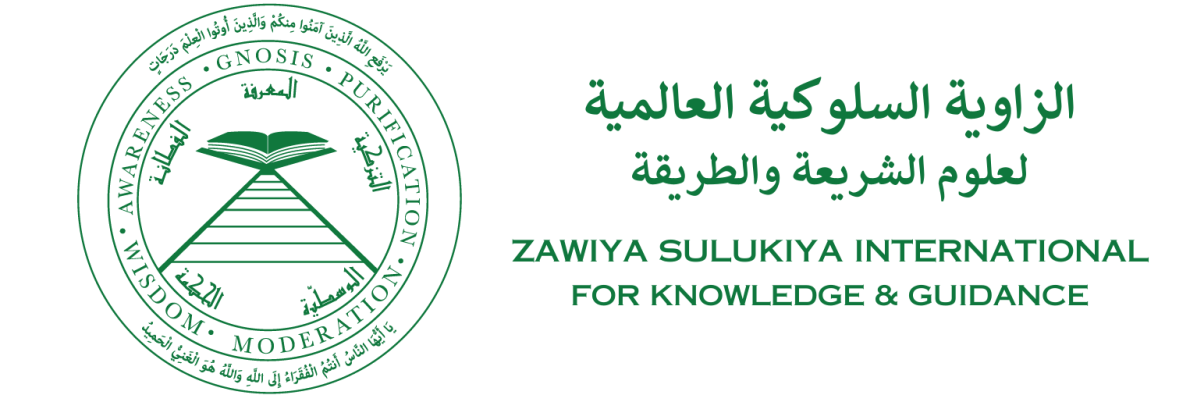
To help us understand this, the Shaykh of Zawiya Sulukiya Institute draws parallel the notion of faqr to the value of zero. The number zero, as researched and explained by Muslim mathematicians, represents the worth of nothingness. When the number and its value is multiplied in society, it still equates to zero, to a state of need of Allah among the members of the society. Only when it is added to an outside influence – an ego –can the state of faqr be dissolved. It is within this zero (0), represented by a circle in almost all linguistic and mathematical languages, does a state of poverty exist through wanting and desiring Allah. For this precise reason, the Zawiya Sulukiya stamp consists of the five pillars surrounded by a circle of faqr, as such those who attended an institute such as a Zawiya, Tekke or Khanaqah all over the Muslim world were all titled ‘fuqaraa’. To benefit and develop from the programs of Zawiya Sulukiya Institute, understanding the notion of faqr and being a faqir is vital.
 Zawiya Sulukiya Institute